
Rules of the Game

The majority of rules exist for safety reasons, designed to protect both rider and horse. These should be taught early so they become natural before players build up speed.
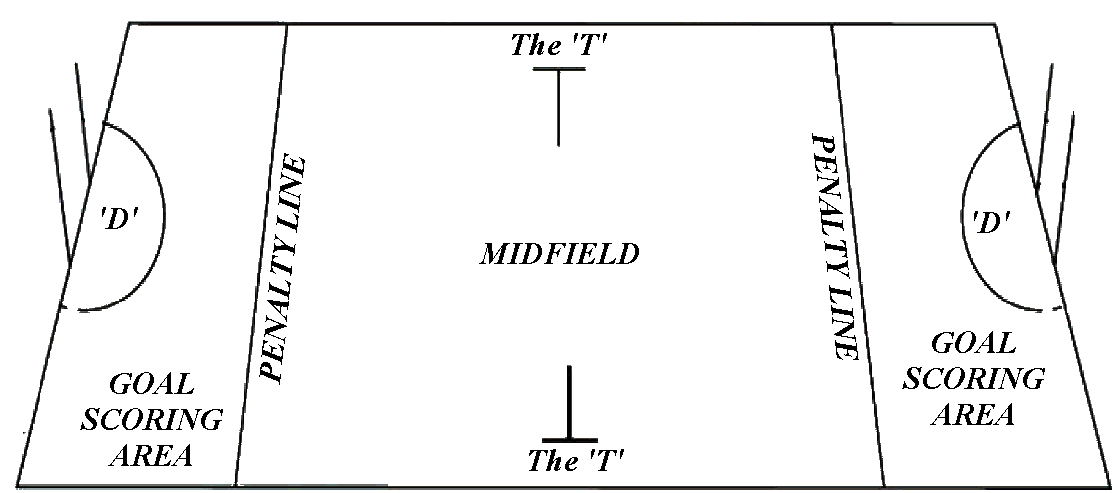
Polocrosse pitch diagram showing goal scoring areas, penalty lines, midfield and the T

Playing Numbers

Playing Numbers

All players are allowed in the mid-field area between the goal scoring areas. Number 1 is the 'Attack' player — the only one allowed in the opponent's goal scoring area and the only one who can score. Number 2 is the mid-field player, not allowed in either goal scoring area. Number 3 is the 'Defence' player — the only member allowed in their team's goal scoring area.

The Line Up

The Line Up

The game starts (and restarts after each goal) with a line out on the 'T' at the centreline of the pitch. Each section lines up on their side, side by side with the other team, in front of the umpire who throws the ball over their heads. After each goal the side alternates. If the ball goes off the edge off a horse, the game recommences with a line out where it left the pitch.

Crossing the Penalty Line

Crossing the Penalty Line

When entering or leaving the goal scoring area while carrying the ball, the player must bounce it over the line so they do not carry it as they cross. This stops players simply galloping and throwing the ball in. The ball must touch the ground on the far side before the player may catch it. The ball may be passed over the line to a player without needing to touch the ground.

Scoring a Goal

Scoring a Goal

Only the Number 1 can score — they are the only attack player allowed in the goal scoring area. The No. 3 cannot score an own-goal. A goal is scored when the Number 1 deliberately throws the ball between the goal posts from within the goal scoring area but outside the 'D'. Accidental deflections do not count. The umpire decides whether the throw was deliberate.

Carrying the Ball

Carrying the Ball

A player may only carry the ball on the nearside (stick side). If the ball crosses the centreline of the horse — except when throwing overarm — it is a penalty. When picking up offside, the ball must immediately be brought to the nearside. A player may be right or left handed; their 'nearside' is the side of the hand holding the racquet. A player may not swap racquet hand during a game.

Ball Going Out of Play

Ball Going Out of Play

If the ball (or a player carrying it) steps on or over the side or back line then a penalty is awarded to the other side, unless the ball went out off a horse. The penalty is taken from where the ball exited the pitch. If the ball went out off a horse the game restarts with a line out there (moved 5m away if close to the backline or penalty line).

Penalties

Penalties

When given a penalty, the player must throw the ball at least 10m before anyone touches it. If they pick it up themselves it must bounce first. A direct pass to another player does not need to touch the ground. No one may interfere until the taker has also travelled 10m. All others must start 10m away. For beginners, flexibility may be shown in the 10m rule — ask the umpire if unsure.

Safety Rules

These rules exist purely to prevent injury to horses and riders. They are non-negotiable at all levels of play.
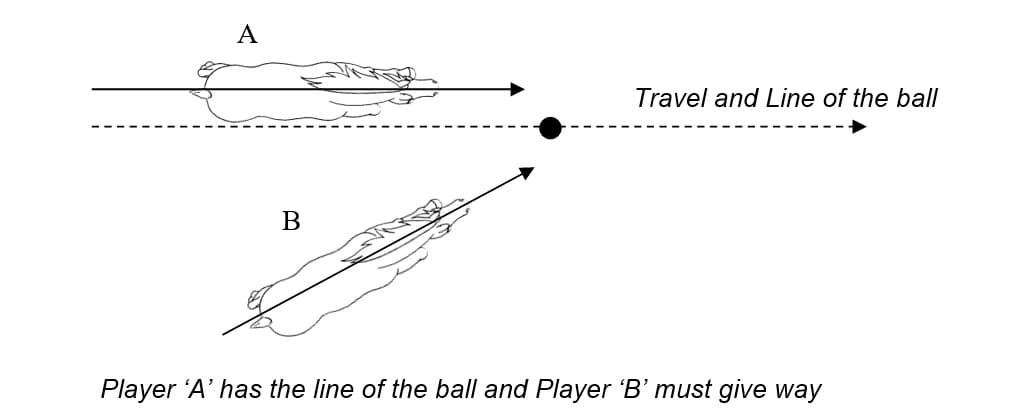
Line of the Ball

Line of the Ball

The "line of the ball" is an imaginary line running along the line the ball is travelling, continuing indefinitely past its present point. Crossing the line of the ball could result in a dangerous collision — commonly called a "T-bone".

Players must learn to recognise the line of the ball at any moment and avoid cutting across it. Entry on to the line of the ball is only allowed at a very small angle, or far enough in front of play for it to be safe. How far is "safe" depends on the speed of players following the line.
Stopping / Turning on the Ball

Stopping / Turning on the Ball

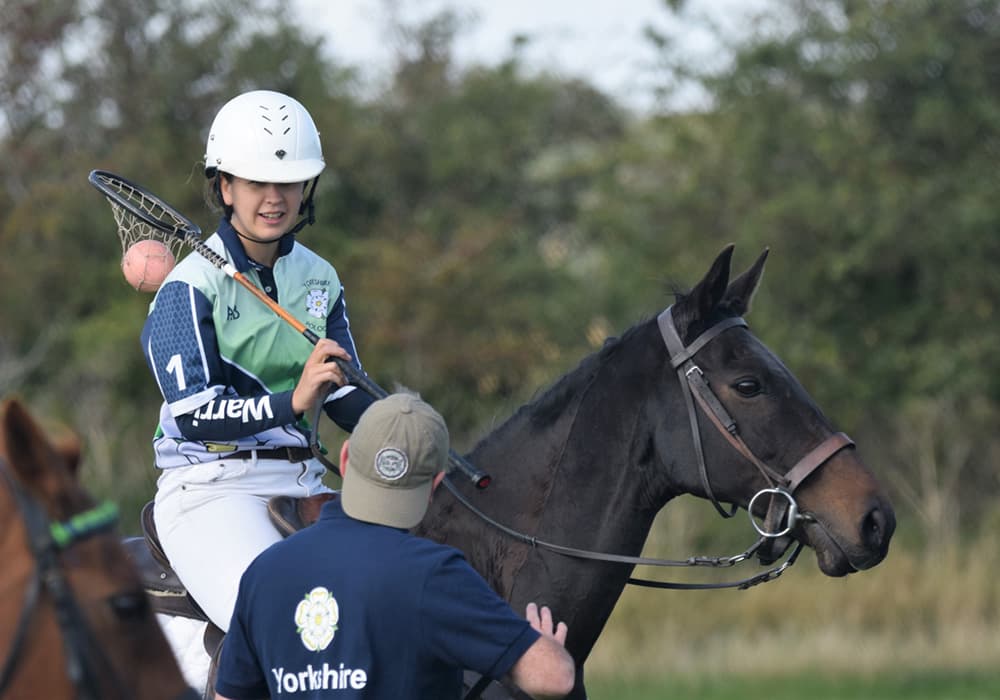
Players must not stop on the ball (e.g. if they miss a pickup) but must continue on past it until it is safe to turn or stop. Stopping on the ball could result in the other five players careening into the back of the stopped player.

Players must also not turn on the ball while running over it or just past it — this could cause the other players to run into the side of the turning player. Players must check behind themselves first to see whether it is safe to turn or stop.
Crossing In Front of or Behind a Horse

Crossing In Front of or Behind a Horse

When crossing in front of or behind another horse you must always leave a sufficient gap to prevent one tripping the other. If a horse has to lift its head over another horse's rump in order to turn, they are too close.

At higher speeds the required distance is greater. The player changing direction is at fault.
Contact Between Horses — Riding Off & Doubling Up

Contact Between Horses — Riding Off & Doubling Up

Physical contact is allowed between horses but only in a controlled fashion. The initial contact must not be sufficient to move the horse off its line of travel. Once contact has been made, pressure can be applied to move the horse — this is "riding off".

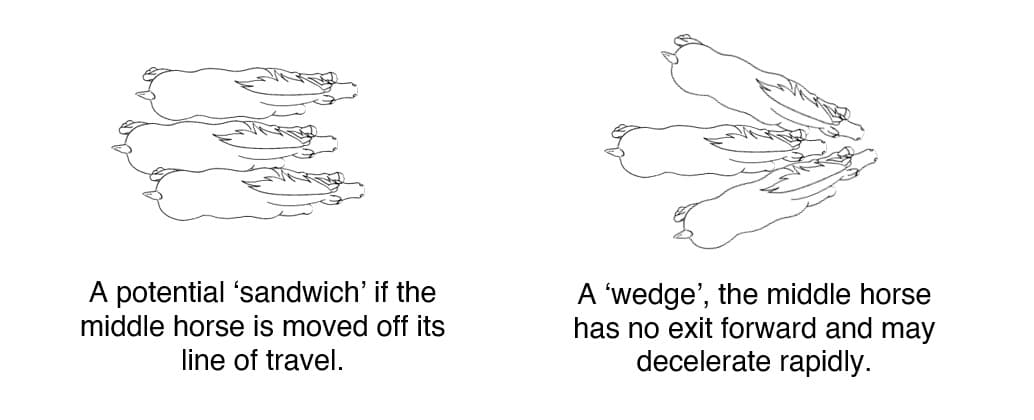
Doubling up is where two players position themselves either side of an opponent. Any movement of the middle player from their line of travel is not allowed, even after initial contact. "Sandwiching" (too much pressure) and "wedging" (two players slightly ahead forming a wedge that decelerates the middle horse) are both strictly illegal.